
13. योगक्षेमं वहाम्यहम् – Introduction to Bhagavad Gita Chapter 9 : I Carry what devotees lack and preserve what they have

The ninth chapter, situated in the middle of the Bhagavad Gita, holds significant importance in various aspects. Shri Krishna himself highlights the importance of it by calling it राजविद्या राजगुह्यं, which translates to the most secret knowledge or the king of all knowledge.
In addition to राजविद्या राजगुह्यं, the first two Shlokas of this chapter add several other adjectives that emphasize the importance of the knowledge taught here. Moreover, this chapter not only imparts knowledge (ज्ञान) but also provides practical methods for applying it in our daily lives, enabling us to transform knowledge into a living experience (विज्ञान).
Additionally, Shri Krishna himself makes two of the most important promises to followers of the spiritual paths. One, योगक्षेमं वहाम्यहम्, meaning he will protect what they have and provide what they need, both spiritually and materially. Second, न मे भक्त: प्रणश्यति, meaning his devotees never perish.
Starting December 2024, over the ten months, we wrote 1-2 posts per week, along with their Hindi translations explaining each of the Shlokas of this chapter.
This book summarizes all those posts into a book format for easier reading and sharing.
Apple Books (Free):
English: http://books.apple.com/us/book/id6753151937
Hindi:http://books.apple.com/us/book/id6753215860
Google Drive (Free):
English: https://drive.google.com/file/d/1HTjvBhkTtTUcpPKhNzBUgMW2Krpvww4_/view?usp=sharing
Hindi:https://drive.google.com/file/d/1KROO1iGRbL1iuQrmj7sO0b-0uXZgH3eD/view?usp=sharing
12. परमां गतिम् – Introduction to Bhagavad Gita Chapter 8 : Always be situated in Yog (union with God)

The eighth chapter of the Bhagavad Gita focuses on leaving the body to attain self-realization or Moksha. The chapter discusses the importance of leaving the body by being situated in Yog (One with God) and methods to achieve that.
The chapter also delves into the concepts of Lokas, Yuga, MahaYuga, Kalpa, and the life of Brahma Devji and how we can go beyond it.
The chapter ends by describing Paths of Brightness and Path of Darkness and how to choose the Brightness path for attaining self-realization.
Starting July 2024, over the five months, we wrote 1-2 posts per week, along with their Hindi translations explaining each of the Shlokas of this chapter.
This book summarizes all those posts into a book format for easier reading and sharing.
Apple Books(Free):
English: http://books.apple.com/us/book/id6739185878
Hindi: http://books.apple.com/us/book/id6739185737
Google Drive(Free):
English: https://drive.google.com/file/d/1WibXIfIPmM8oph3d8RzCiqRMuQ4FK8Q3/view
Hindi: https://drive.google.com/file/d/1AQ1RoVCKQdyGC7aJvBlsfKFkLvZ_xBPH/view
11. वासुदेव: सर्वमिति – Introduction to Bhagavad Gita Chapter 7 : Brahman alone exists

Many scholars divide the Bhagavad Gita into three sections – chapters 1-6 covering who we are and why we exist, chapters 7-12 covering description of Sagun Brahman or God, and chapters 13-18 focusing oneness between us and the Sagun Brahman or God.
In this context, the second section about Sagun Brahman starts in the seventh chapter, and Shri Krishna spends a great deal of time explaining the attributes, characteristics, and capabilities of the Sagun Brahman.
Starting November 2023, over the last eight, we wrote 1-2 posts per week, along with their Hindi translations explaining each of the Shlokas of this chapter.
This book summarizes all those posts into a book format for easier reading and sharing.
Apple Books(Free):
English: http://books.apple.com/us/book/id6544803220
Hindi: http://books.apple.com/us/book/id6544803983
Google Drive(Free):
English: https://drive.google.com/file/d/1plB12s4b2A5kMaqjXmWzgiq77ckH9Fmq/view
Hindi: https://drive.google.com/file/d/1szqRrSjjTuPIPVYgT86wY5P-_0cuMKeR/view
10. असतो मा सद्गमय, Introduction to Vedanta – Vol 1 : Collection of Posts from LinkedIn (Posts 1 – 108)
Starting from the first week of May’2022, over almost the last two years, we published a series of 108 posts on LinkedIn covering various concepts and questions from Vedanta.
Vedanta is the knowledge given in Upanishads, Bhagavad Gita and Brahma Sutras. Using these, acquiring Vedantic knowledge involves three steps – Shravan (Study), Manan (Contemplation), and Nidhidhyasan (Meditation).
The first two steps require the seeker to study and ask questions to make their understanding concrete so that they can Meditate on it to make Vedantic teachings a reality.
This book aims to support the first two steps by answering questions and clearing doubts to help readers progress on spiritual paths.
Apple Books(Free):
English: http://books.apple.com/us/book/id6477942027
Google Drive (Free):
English: https://drive.google.com/file/d/1W69bQYNNqboZ9XKbROGpiYnlYqR1KwMw
9. शिवोऽहम् – Introduction to Bhagavad Gita Chapter 6: Transformation From Knowing to Living Vedanta
Having taught the nature of Brahman, our true identity as Brahman along with the importance of Karma Yoga in chapters 2-5, the sixth chapter of Bhagavad Gita focuses on teaching the methods of निदिध्यासन (meditation).
However, in this chapter, Shri Krishna not only explained how to do meditation but also gave the prerequisites, logistics, and the process of meditation along with the ultimate achievement of self-realization, and finally, the significance of practice and Shraddha in this whole process.
This way, the sixth chapter of the Bhagavad Gita is a complete handbook on निदिध्यासन/Meditation. We must use this knowledge and break the barrier of the physical dimension of this universe and reach the ultimate state of self-realization where we can say – चिदानन्दरूपः शिवोऽहम् शिवोऽहम्!
Apple Books(Free):
English: http://books.apple.com/us/book/id6472616684
Hindi: http://books.apple.com/us/book/id6472616897
Google Drive (Free):
English: https://drive.google.com/file/d/1TwJSzzT8J_g-Q3JvhjdyzFjp1cVWa-Ym/view
Hindi: https://drive.google.com/file/d/1JW0SQlrkkH_ZkF0-DttuhKFYg7Noh0WL/view
8. आदित्यवत् ज्ञान: Introduction to Bhagavad Gita Chapter 5 – Blazing Knowledge of Brahman Liberates Us
The fifth chapter starts with Arjun asking which is superior, Karma Sanyas or Karma Yoga. Shri Krishna says without a doubt that Karma Yoga because it is the path that everyone can follow.
For most, Karma Sanyas is impossible to follow as we find it difficult to give up all our duties, relations, and possessions. Even if we try to give them up, our mind+senses revolt and make it harder for us to progress on the spiritual path.
Therefore, Karma Yoga is better for most, as it is easier to let body+mind do what it needs without getting attached to the activities or their results. Shri Krishna even adds that people who follow Karma Yoga are also Sanyasis, as they give up on the fruits of their actions.
Karma Yoga purifies our minds and opens the doors of higher spiritual knowledge, understanding, and experiences, taking us to the highest state of self-realization, where we will achieve a perpetual state of blissfulness, even while being in this body.
Towards this, the Shlokas 2 to 12 from this chapter focus on karma yoga and the purification of the mind. The Shlokas from 13 onwards concentrate on the highest state of self-realization, where we understand who is the real doer and what is our true identity.
Towards the end of this chapter, in Shlokas 26-27, Shri Krishna also emphasizes the importance of meditation/Nidhidhyasan as, without that, knowledge only stays as just the knowledge in the brain and does not become a living experience.
Shlokas 26-27 also act like a cliffhanger for the topic of meditation, which gets covered in great detail in the sixth chapter.
Apple Books(Free):
English: http://books.apple.com/us/book/id6447632336
Hindi: https://books.apple.com/us/book/id6447639748
Google Drive (Free):
English: https://drive.google.com/file/d/1Q18nb-_Z762IqIl1Ru–K3Ni5nI24hgF/view
Hindi: https://drive.google.com/file/d/1xkbgUgW5CTjMmZ9hIK1_swXDki1SgKKp/view
7. जीवन यज्ञ: Introduction to Bhagavad Gita Chapter 4 – Do Work Knowing Everything Is Brahman
The fourth chapter of the Bhagavad Gita is very special because it is the first time Shri Krishna has revealed his divinity and instructed how his birth is different from all of us.
We all are born helplessly under the influence of Maya to reap/repay our Prarabdha Karama. But, for Shri Krishna, there is no Sanchit or Prarabahda, so a divine birth or Avatar happens using the divine power of Maya.
The Shlokas 4.7 and 4.8 explain that whenever there is a decline in righteousness, Avatar takes birth to help restore it by helping righteous people and punishing the evildoers.
Shri Krishna goes on to explain the Chaturvarna and the roles associated with each of them. Shlokas 18-24 explain how an enlightened person sees action in inaction and inaction in action and how one can do their duties with the spirit of Yajna/Sacrifice and reach the enlightened state of seeing Brahman in everything as explained in the 24th verse.
The Shlokas 25-30 provide a list of 12 Sadhanas or practices. If we could do those Sadhanas with the spirit of Yajna, it could help us purify our minds and make us eligible for the state of enlightenment given in the 24th verse.
The remaining Shlokas from 31 to 42 emphasize doing our duties and regular Sadhanas, if needed, recommend we take help from a Guru to stay steadfast on the spiritual path.
Apple Books(Free):
English: http://books.apple.com/us/book/id6445235404
Hindi: http://books.apple.com/us/book/id6445236245
Google Drive (Free):
English: https://drive.google.com/file/d/1I6yl779LbVZl2wEkTRwC-Y_dkyIAunwA/view
Hindi: https://drive.google.com/file/d/1aWB54mxmdq9x0loyH8m3-6DbuDqypMDy/view
6. प्रसाद बुद्धि: Introduction to Bhagavad Gita Chapter 3 – Do Good Because Doing Good Is Good
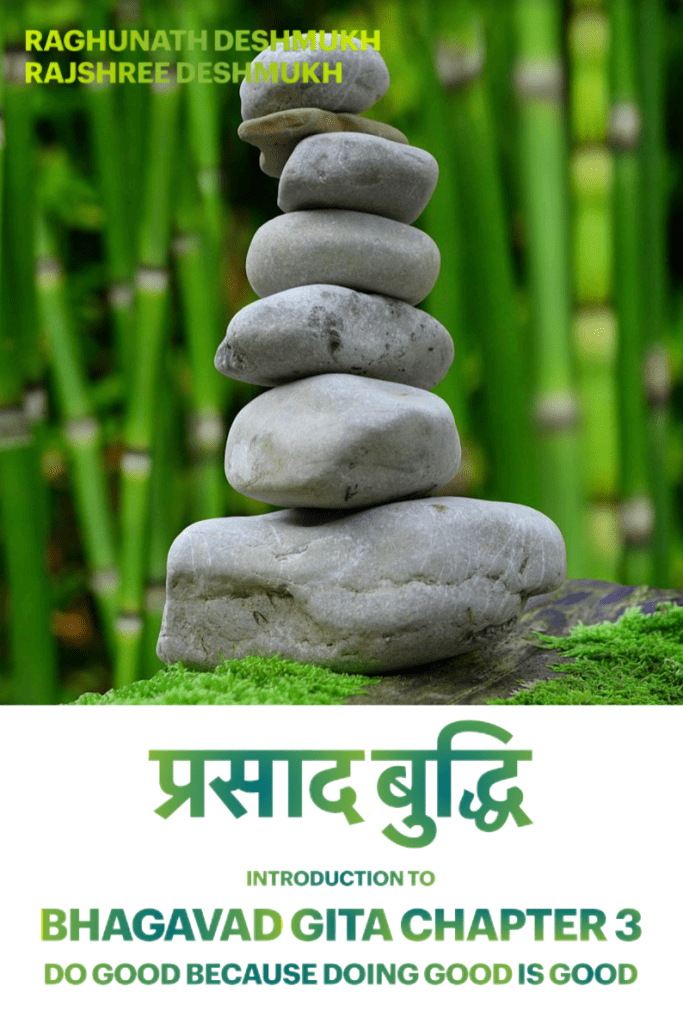
Chapter 3 starts with the question from Arjun and then Shri Krishna explains how Karma Yoga purifies our minds and sets us on the path of self-realization.
In this chapter, Shri Krishna also helps us understand different ways we can follow Karma Yoga, along way approaches we can take to kill the biggest enemy on the path of self-realization, i.e., our desires and Vasanas.
Apple Books(Free):
English: http://books.apple.com/us/book/id6443269748
Hindi: http://books.apple.com/us/book/id6443269839
Google Drive (Free):
English: https://drive.google.com/file/d/1PpDx7_OD7L-udbvK5OzN72XUJAUIaXTj
Hindi: https://drive.google.com/file/d/1IW9c0orWV5ScrjpW57kZdRC0X72hAEap
5. सांख्य-ज्ञान योग: Bhagavad Gita Chapter 2 – All That Shri Krishna Wanted To Tell.
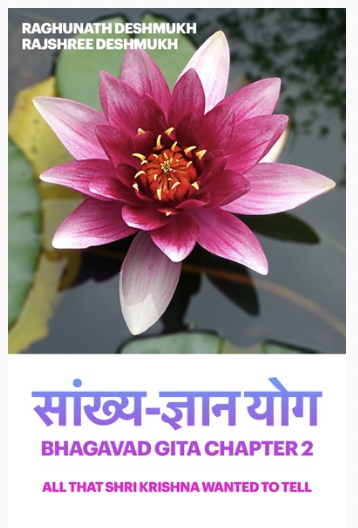
Second chapter of the Bhagavad Gita is all Shri Krishna wanted to tell Arjun when he suddenly developed cold feet during the Kurukshetra war.
If we could understand and follow this advice, we don’t have to do anything else. We don’t have to read the remainder of the Bhagavad Gita or for that matter, any other scripture too. This one chapter is enough to take us to self-realization. Just follow this, and Moksha or Self-Realization is already ours.
Apple Books(Free):
English: http://books.apple.com/us/book/id1621978387
Hindi: http://books.apple.com/us/book/id1621978859
Google Drive (Free):
English: https://drive.google.com/file/d/1DA4sTWscIcGpi0PVP4IjUnBAdxWEg7MW
Hindi: https://drive.google.com/file/d/177TpMmdlc2b-JLtD5ufH2BzzCpNj7wp4
4. प्रज्ञानम् ब्रह्म – Consciousness is God, Consciousness is Us.
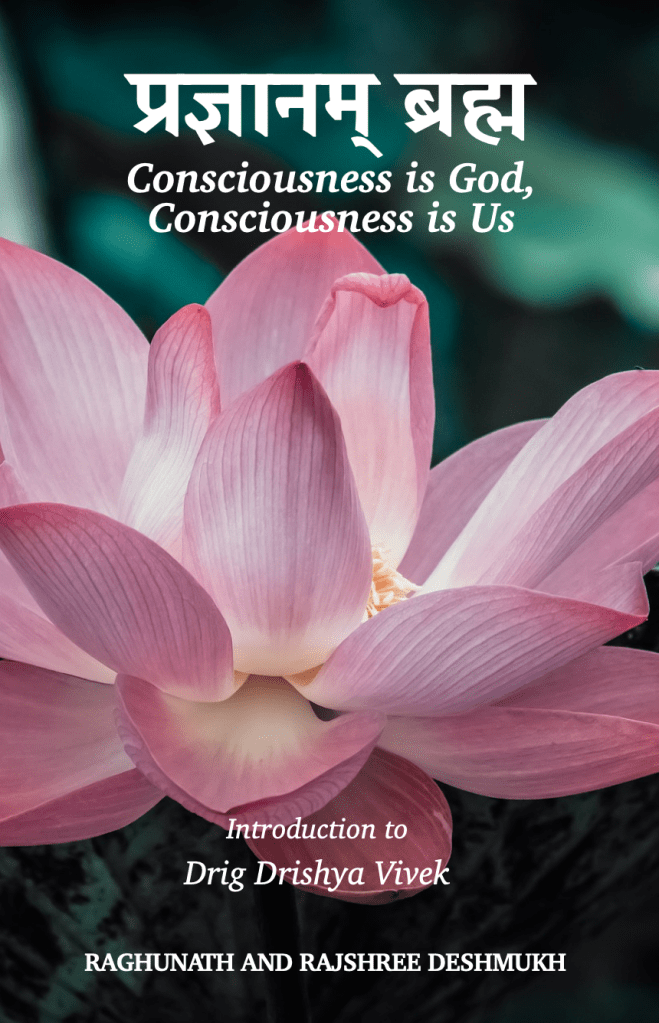
Drig-Drishya-Vivek uses simple logical reasoning to show us that we are not the body and mind. It then gives us step-by-step guidance and meditation technique to help us reach the self realization.
It is a Prakaran Grantha of Vedanta, as it focuses on path of knowledge. This Grantha has 46 verses.The first 31 verses cover the main portion of teaching, while the verses from 32-46 mainly cover the topic of being or जीव.
It is widely accepted that the 13th-century scholar, Vidyaranya Swami is the author of the Drig-Drishya Vivek. But, there are few groups that believe that Adi Shankaracharya has written this.
In this book, We will go through each of the verse and try to understand the meaning.
Apple Books (Free):
Hindi: http://books.apple.com/us/book/id1597701221
English: http://books.apple.com/us/book/id1597700198
Google Drive (Free):
English: https://drive.google.com/file/d/1KiBOrlX_b7VFD7FjvDV5jNdx9FMM9qnI/view
Hindi: https://drive.google.com/file/d/1JQq_dCDnxplXF7R7fkCOldhMnBSjD08D/view
Amazon.com (English Paperback for Purchase) :
https://www.amazon.com/dp/B0B5P8LYVS/ref=cm_sw_em_r_mt_dp_Z72KKEER62MQAKXTK35X
3. ईशावास्यं इदं सर्वं – Introduction to Isha Upanishad
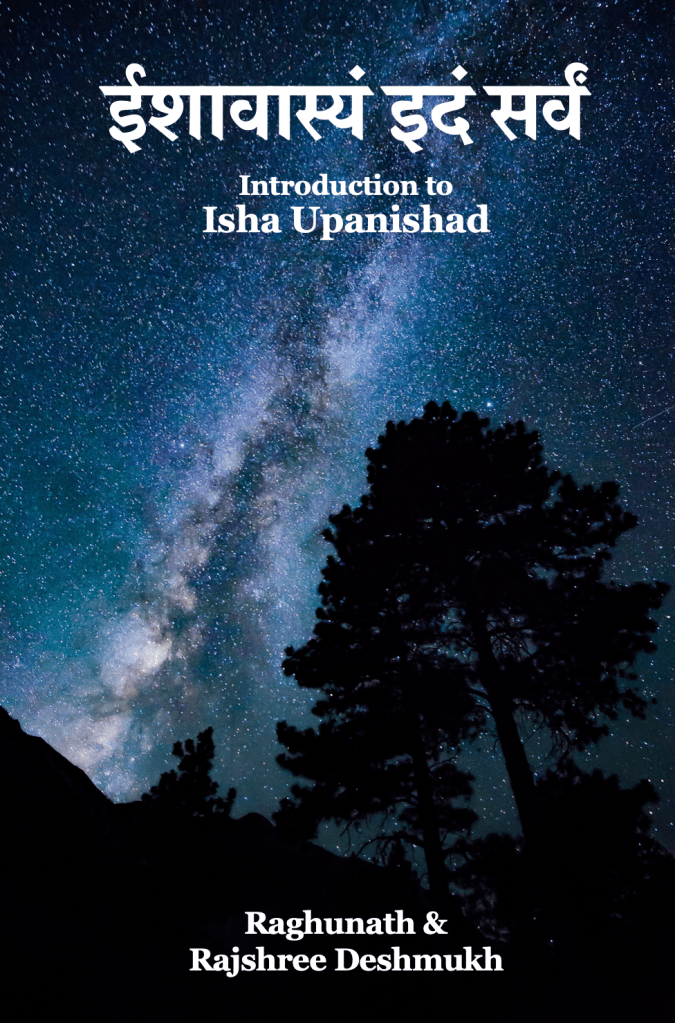
Isha Upanishad is one of the Primary Upanishads explaining key concepts of Vedanta. Between April to July’2021, we took each of the mantras of this upanishad and wrote illustrations as Facebook posts. This book is a compilation of all those posts.
Apple Books (Free):
Hindi: http://books.apple.com/us/book/id1577047104
English: https://books.apple.com/us/book/id1577046232
Google Drive (Free):
English: https://drive.google.com/file/d/1ytncRw6V6-CMQgHJdWvU38Pr_uJWmrNL/view
Hindi: https://drive.google.com/file/d/1o2faAaIWCeDHhEKWn8OzofYqUNkt3ond/view
Amazon.com (English Paperback for Purchase) : https://www.amazon.com/dp/B099BYLLSJ/ref=cm_sw_em_r_mt_dp_G8R4MQNC5D2ABBPWNPP0?_encoding=UTF8&psc=1
2. कमल पत्र – Bhagavad Gita Chapter 18 – Through Facebook Posts
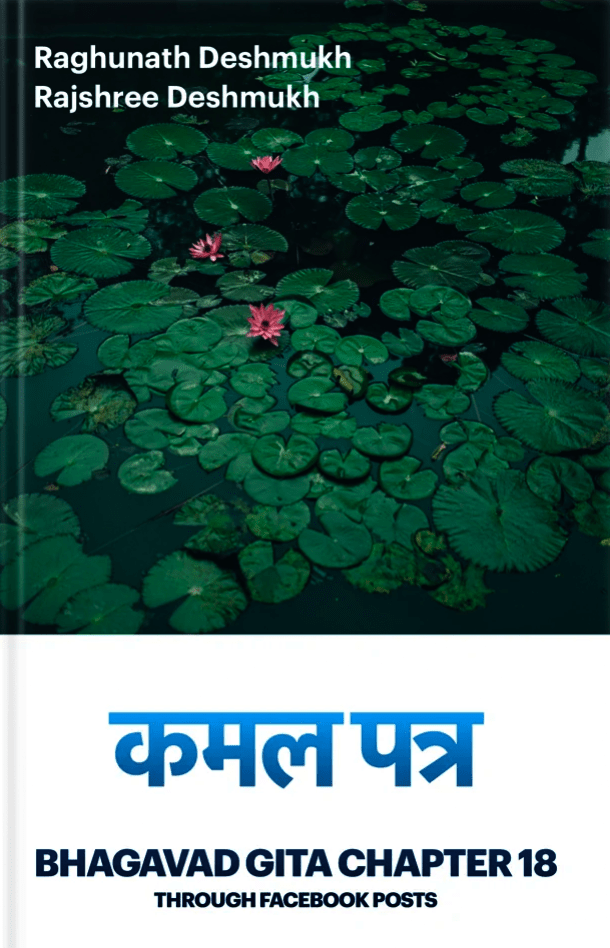
Bhagavad Gita Chapter 18 summarizes all the teachings of Bhagavad Gita. Between Nov’2020 to March’2021, we took each of the shlokas of this chapter and wrote illustrations as Facebook posts. This book is a compilation of all those posts.
Apple Books (Free): http://books.apple.com/us/book/id1557814475
Google Drive (Free): https://drive.google.com/file/d/16gPnm_sVPDGWV7yyQ_J7DcUDyMjeim9o/view
Amazon.com (English Paperback for Purchase) : https://www.amazon.com/dp/B09765MML3/ref=cm_sw_em_r_mt_dp_EFGK09RGCKQQ36CQ70AM?_encoding=UTF8&psc=1
Amazon.in (English Paperback for Purchase) : https://www.amazon.in/dp/1637541627/ref=cm_sw_em_r_mt_dp_HDNX3TB0VPNW4AAKJ8HQ?_encoding=UTF8&psc=1
Pothi.com (English Paperback for Purchase) : https://store.pothi.com/book/raghunath-deshmukh-bhagavad-gita-chapter-18-through-facebook-posts/?fbclid=IwAR03ZLkvRdFhu9zSz-T2GOwEdPYm3FW1vGB4VS4600Nw8fzke4MFEJpzXWg
1. तमसो मा ज्योतिर्गमय – Introduction to Vedanta
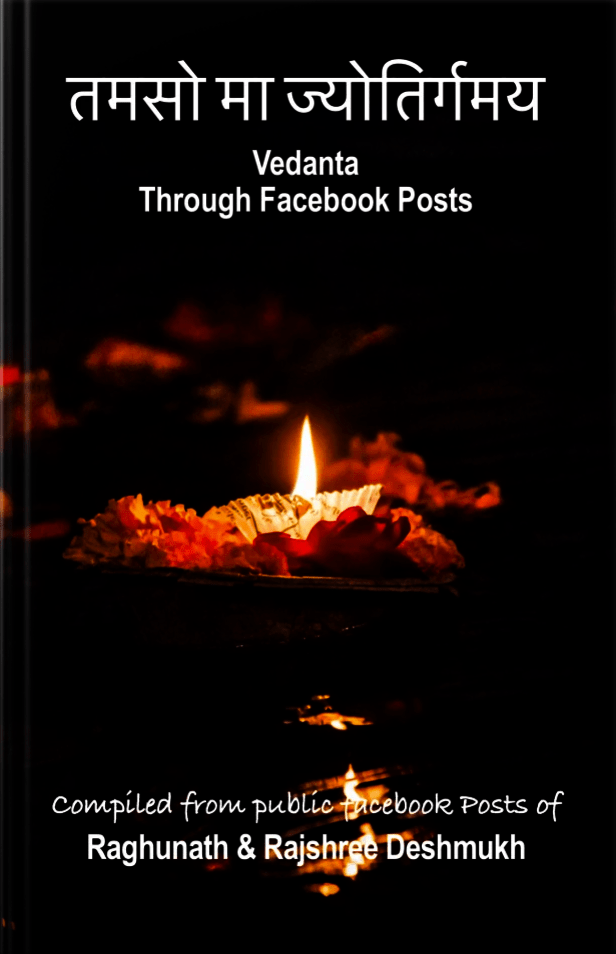
Write-ups on high-level concepts of Vedanta written as facebook posts between April-Dec’2020 have complied in a book format. Each post covers a different topic.
Apple Books (Free): https://books.apple.com/us/book/id1548400528
Google Drive (Free): https://drive.google.com/file/d/1a-lgBDDCfnpm9ugw_EPlLPEQorRWe8o_/view
 Vedanta
You must be logged in to post a comment.